Sara and her father’s relationship
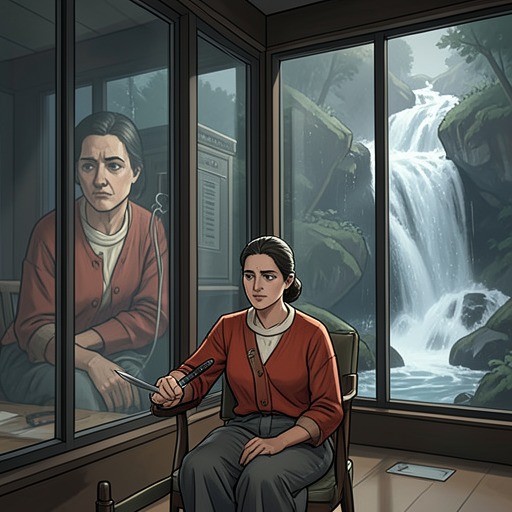
Dark Lies the IslandSara and her father’s relationship combines practical support and persistent concern with a deep failure of understanding. During Sara’s crisis, he offers her the keys and alarm code to the family’s remote holiday house, checks on her from Granada, and urges her to speak to her mother. Sara, meanwhile, experiences his explanations and appeals to blood ties as inadequate to what she is going through; the distance between them is sharpened by the house he designed, where his care and her isolation occupy the same space.
Care and Practical Support
After completing her Leaving Certificate with enough points for Medicine or Veterinary studies, Sara takes a year out and stays alone at the family’s holiday house in County Mayo. When she asks her father for the keys and alarm code, he gives them to her, enabling her to go there. The gesture is practical rather than a cure for her distress: Sara has not been sleeping properly for months, and the evidence of her self-harm is already present when she arrives.
The house makes their connection tangible. Her father, a radical architect who has rethought the idea of walls, designed the glass-and-angles building for family summers. A bog stream runs beneath its open-plan interior, visible through a thick glass floor. He has driven Sara there, then left the kitchen knives in their usual place. Those details hold two sides of his care together: he has provided the keys and the retreat, yet the house’s openness, its remote setting, and the accessible knives leave Sara alone with hazards he has not removed.
Distance Across the House
Although her father is away in Granada, he phones nightly and presents himself as casual when he checks in. Sara knows that he will call after dinner and drinks, but the familiar ritual does not make the conversation easy. She has disabled voicemail and weighs how long to leave the phone ringing before she answers. Their contact therefore carries both attachment and resistance: he keeps calling, while she controls when and whether to respond.
The distance is not simply geographical. Her father describes the surrounding bog as wounded, looking out at it with feeling, whereas Sara’s attention turns to the house’s eerie views, its silence, and the water and coast beyond it. The landscape that he frames as an object of reflection becomes part of the isolated setting in which she is trying to endure her crisis. His architectural vision gives her shelter, but its glass walls and exposed views do not supply the understanding she needs.
Disagreement About Her Distress
The sharpest divide appears when her father asks her to talk to her mother. He explains that her mother does not mean to be the way she is; Sara hears this as a defence of the person from whom she is estranged and challenges him. He insists that he would be the last to defend her mother, but asks Sara to speak to her anyway. His response seeks to maintain a family connection, while Sara refuses to treat that connection as an answer to her pain.
He also says he knows what Sara is going through and acknowledges that it has been a very hard time. Sara rejects the claim: he does not know. He answers that he does know, and invokes blood as a reason he cannot simply stop trying. Sara counters by asking what blood has given her. She ends the call and switches off her phone. The exchange establishes a consequential limit to his persistence: his appeal to kinship does not persuade her to continue the conversation, and the call closes without reconciliation.
Care Without Resolution
Her father’s language also shows how he attempts to make sense of Sara’s condition. He tells her she is not mad but addicted to the internet. Sara’s experience, as presented in the same sequence, includes much more than that explanation accounts for; the narrative explicitly places it alongside her fear, medication, and perceptions that he does not explain away. His reassurance is evidence of concern, but its narrowness exposes the distance between his interpretation and her lived crisis.
Even after the phone call, the father remains present through objects. Sara wraps herself in his mustard-coloured duffel coat, and its association with him accompanies her as she goes outside and sits looking over Clew Bay. This brief act of taking comfort from something of his does not undo her rejection of his arguments or resolve their conflict. It makes the relationship more complicated than either estrangement or dependable rescue: she can refuse his account of her pain and still turn, in isolation, toward an object that connects her to him.
The relationship consequently remains unresolved. Her father repeatedly reaches out, offers access to the family house, and tries to preserve communication through the language of blood; Sara needs more than those gestures and refuses to mistake them for understanding. His presence survives the failed exchange, but the passage offers no repaired bond—only an uneasy mixture of care, frustration, and attachment.